
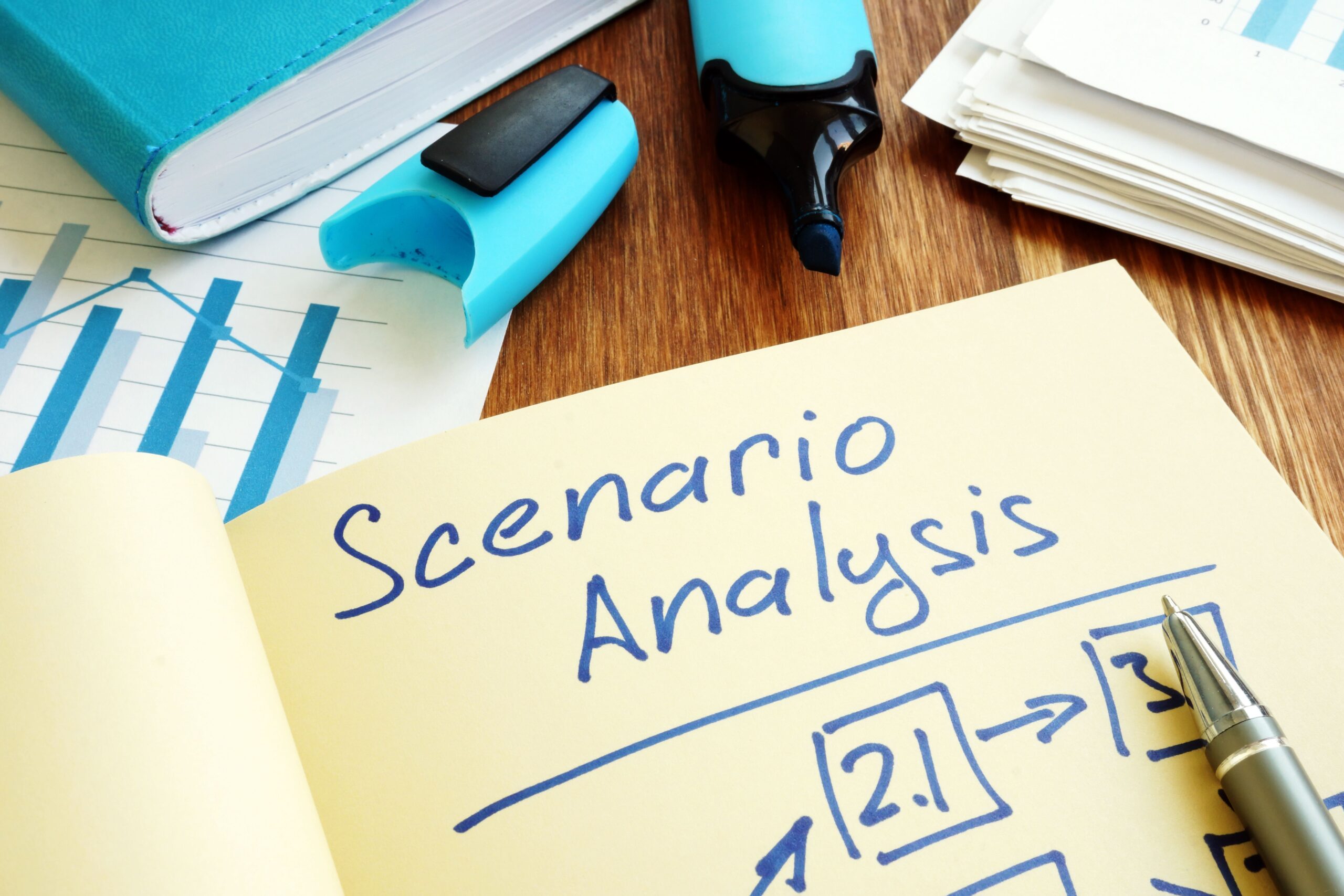
Scenario planning is a structured method for exploring possible futures. Instead of trying to predict what will happen, organizations use scenario planning to build a set of plausible ‘what if’ stories and prepare for each one. The result: better decisions today, whatever tomorrow brings.
This article explains what scenario planning is, why it works, where the method comes from, how famous organizations have used it, and the step-by-step template you can apply yourself. It is one of the core methods I use as a strategic foresight expert, both in keynotes and in hands-on workshops.
If you would like to work with me on scenario planning, please contact me. Or check out the Strategic Foresight page first for more information, examples and references.
What is scenario planning?
Scenario planning is a strategic foresight method in which you develop several coherent stories about how the future could unfold, and then use those stories to stress-test your strategy. Scenarios are not forecasts. They are structured explorations of ‘what if’ situations: what if a cheap competitor enters from China, what if a government imposes new rules, what if a technology breaks through faster than expected?
Most organizations plan for a single future: the one they expect. Scenario planning challenges that assumption. By building multiple plausible futures, teams develop the strategic flexibility to respond, regardless of what actually happens. The goal is not to guess the future correctly, but to build robust plans that hold up across a range of futures.
This matters because the environment of most organizations has become what strategists call VUCA: volatile, uncertain, complex and ambiguous. Technological change, geopolitics and shifting markets make the outcomes of your own actions hard to predict. As the philosopher Bruno Latour put it, unexpected consequences are among the most predictable things on earth. Scenario planning is a disciplined way to prepare for exactly those consequences.
The most important thing to remember is this: scenarios should inform, inspire and confront you. They are a thinking tool that helps you break out of rigid patterns and the comfortable belief that things will stay as they are.
Why scenario planning works
The strength of scenario planning lies less in the final scenarios than in the conversation it generates. In my work I see four benefits of working with scenarios, a useful way to understand why the method is so effective:
- Cognitive: scenarios help you order a complex reality. They are a structured thinking exercise.
- Communication: building scenarios is an interactive process with managers, employees and stakeholders. It creates a shared language and collective images of the future.
- Creative energy: thinking in scenarios sparks new ideas and innovation.
- Commitment: people who help build the scenarios are far more invested in the strategy that follows from them.
In my own work, two benefits stand out. First, scenario planning pulls people out of ‘here and now’ thinking. Our brains are wired to assume everything stays the same, and scenarios force us to imagine other worlds. Second, the method gets conversations going: what does this future mean for us, what do we like about it, what worries us?
A vivid example comes from a two-day workshop I ran for a Dutch safety region (Veiligheidsregio Zuid-Limburg). Their scenario team explored a ‘what if’ in which high water breaks through a dike near a canal with houseboats: what would we do, who would we need to coordinate with, what must we arrange? A few weeks later, that exact situation occurred. Because they had already rehearsed the scenario, they were far better prepared. Just as an athlete trains before a match, scenario planning lets you rehearse a future before it arrives.
A short history of scenario planning
People have always wanted to know the future. In ancient Greece, leaders traveled to the Oracle of Delphi to ask the high priestess Pythia for guidance, a kind of divine intervention. Modern scenario planning replaces the oracle with method and imagination, but the underlying question is the same: how do we prepare for what we cannot know?
Several strands led to the method as we know it today:
- Military war games. From Stratego to modern ‘matrix games’, armies have long used simulations to train for combat. Over time these games grew more sophisticated, adding press, diplomacy and economic interests, so that players learn to weigh the objectives and resources of every stakeholder.
- Quantitative simulation. In the 1940s, engineers in the UK built a hydraulic computer of tanks, pipes and colored water (the MONIAC) to model the national economy. In the 1970s, the Club of Rome ran its World3 simulation, modeling resource depletion and environmental loss for the influential report on the limits to growth.
- Qualitative expert methods. The RAND Corporation in the United States pioneered the Delphi method, gathering experts in structured focus groups to discuss what could happen to an industry and how it would affect organizations.
The breakthrough moment came at Shell in the early 1970s.
Famous examples of scenario planning
If you search for scenario planning, the case of Shell comes up first, and for good reason. In the early 1970s, a Shell director named Pierre Wack argued that strategy should not rely on data alone. He championed the use of scenarios and stories. At the time, the oil industry assumed the price of oil could only go up because of scarcity. Wack’s team built several scenarios, including one in which the oil price collapsed. Management discussed what they would do if that happened. When the 1973 oil shock hit, competitors were caught off guard, and Shell was the only major company that was prepared. It rose from eighth to second in the industry.
Since then, scenario planning has been adopted well beyond the oil industry:
- Cisco built scenarios around the future of the internet, weighing factors such as a radical technology breakthrough and shifts in customer demand, to test its business models and policies.
- Microsoft developed scenarios for cloud computing and virtual reality to think through what those futures mean for its products, services and strategy.
- Disney used scenarios toward the end of the COVID-19 pandemic to prepare for reopening its theme parks: visitor numbers, protocols and how guests might react.
- Singapore, facing limited fresh water, uses scenarios to plan for sustainable, long-term water management.
- The Guna Yala community in Panama used scenario planning to discuss ocean and land use, education and cultural heritage. Researchers found it led to more collaboration and shared learning about the community’s future.
The lesson across all of these cases is the same: scenarios are not predictions. They prepare organizations, governments and communities to act with confidence in an uncertain world.
How does scenario planning work? A step-by-step method
A scenario planning process has three core steps, plus an essential step zero. This is the template I use in workshops and strategy sessions.
Step 0: Define your scope
Before anything else, decide the boundaries. What time horizon are you exploring, five, ten or fifteen years? And what is the unit of analysis: your whole organization, a nation, a market, a customer segment? A clear scope keeps the rest of the process focused.
Step 1: Analyze the driving forces
Map the developments that could shape your future. Two models help here:
- STEEP or PESTEL (macro level): scan Social, Technological, Economic, Ecological, Political and Legal factors. For example, an aging population (social), the rise of big data and better algorithms (technological), or an ongoing war (political). Only include what is relevant to your goal.
- Porter’s Five Forces (meso level): look at your industry itself, including the risks of new entrants, substitutes, buyers and suppliers.
Step 2: Build your framework and find the critical uncertainties
Plot each factor on two axes: how important it is, and how uncertain it is. The factors that are both highly important and highly uncertain are your critical uncertainties. These are the forces that will most shape the future and that you can least predict, so they become the engine of your scenarios.
Step 3: Build the scenarios
Choose two critical uncertainties and place them on a vertical and a horizontal axis. This creates a two-by-two matrix with four distinct, internally consistent scenarios. Give each scenario a memorable name.
A few real examples of these axes:
- Automated vehicles: speed of technological development (fast or slow) against policy (restrictive or supportive). One quadrant, fast technology but restrictive policy, was named ‘automated vehicles on standby’.
- Organizational strategy: competitor growth (flat or booming) against talent scarcity.
- Marketing: customer values (neo-traditional or inner-directed) against price point (high or low), an approach used for Detroit automakers.
After the scenarios: wind tunneling
Once you have four scenarios, run your current strategy through each of them, a technique known as wind tunneling. How does your strategy hold up in each future? You may find you have a great strategy for only one of the four scenarios. That is exactly the kind of insight that prompts new strategies and business models.
Finally, make the scenarios come alive. Do not leave them as dry facts. Use your imagination: what does a day in the life of this future feel like? Because scenario planning is not about finding a favorite future. It is about being prepared for all of them.
Using science fiction and storytelling in scenario planning
One of the most powerful ways to make scenarios vivid is science fiction. As Etienne Augé of Erasmus University, Rotterdam The Netherlands, argues in his work on why science fiction helps us study the future, stories let us feel a future rather than just analyze it. Three examples I often use:
- Blade Runner explores the ethical dilemmas of human-like robots, a useful lens for the moral questions around artificial intelligence and robotics.
- Minority Report imagines predictive policing. With big data and AI, we are creeping in that direction, which forces questions about privacy and surveillance. I use it in work for police organizations.
- The Hunger Games depicts an extreme, dystopian future that highlights what social inequality can lead to.
Storytelling is central here. We are storytelling creatures, and a narrative about the future sticks in a way that a spreadsheet never will. It also helps teams break free from the dominant ‘rockets and robots’ image of the future that dominates the media, and explore other, richer possibilities instead.
Scenario planning vs forecasting vs scenario analysis
These terms are often confused, so it helps to separate them:
- Forecasting extrapolates from data to predict a single most-likely future. It works well for stable, short-term questions.
- Scenario analysis in finance usually means testing a model against a few defined cases (best case, base case, worst case) to quantify risk.
- Scenario planning is broader and more strategic. It builds several qualitative, story-based futures around critical uncertainties to inform long-term strategy and resilience. It does not aim to predict, but to prepare.
Scenario planning applications
Scenario planning adapts to almost any theme. These are three areas in which I regularly run scenario planning workshops.
Public organizations
Governments, municipalities and public bodies face long-term, high-stakes uncertainty: climate, demographics, security and technology. Scenario planning helps them pressure-test policy and rehearse how they would respond before a crisis actually arrives, so decisions are more robust and teams are better prepared.
I have run workshops on this theme for the Dutch Police, for safety regions such as Veiligheidsregio Zuid-Limburg, and for municipalities through A&O Fonds Gemeenten, among others.
Innovation
The climate crisis, an aging population and continued technologization are megatrends shaping the future of organizations, governments and society. In this workshop, we explore how a consumer, user or resident lives in the future, what they do and what drives them, using creative work formats that help you think outside the box. It pairs naturally with my work as an innovation and AI keynote speaker.
I have run workshops on this theme at Volvo and Etos, among others.
Human augmentation
Through methods such as genetic modification, brain-computer interfaces and nanotechnology, scientists and companies are increasingly able to enhance humans. In this session, participants describe and depict augmentation technologies of the future, along with their benefits, risks and consequences. It connects closely to my human augmentation keynote.
I have run workshops on this theme at Beam Gent (Belgium), the Goois Lyceum and the University of Eindhoven, among others.
Frequently asked questions about scenario planning
What is scenario planning in simple terms?
Scenario planning is a method for building several plausible ‘what if’ stories about the future and using them to test and strengthen your strategy. It prepares you for a range of outcomes instead of betting on a single prediction.
Who invented scenario planning?
The method has roots in military war games and in the RAND Corporation’s Delphi method. It was made famous in business by Pierre Wack and his team at Shell in the early 1970s, whose scenarios helped Shell anticipate the 1973 oil shock.
What are the steps of scenario planning?
Define your scope (step zero), analyze the driving forces using STEEP/PESTEL and Porter’s Five Forces, plot those forces by importance and uncertainty to find the critical uncertainties, then build a two-by-two matrix of four scenarios. Afterwards, wind-tunnel your strategy against each scenario.
How many scenarios should you create?
Most scenario planning uses two to four scenarios. The classic approach takes two critical uncertainties and combines them into a two-by-two matrix, producing four distinct futures that are different enough to be useful but few enough to work with.
Which companies use scenario planning?
Shell is the best-known example, but scenario planning is also used by companies such as Cisco, Microsoft and Disney, by governments such as Singapore, and by communities and public bodies, including safety regions and the Guna Yala community in Panama.
Is scenario planning the same as forecasting?
No. Forecasting predicts a single most-likely future from data. Scenario planning deliberately builds several qualitative futures to prepare for uncertainty. As Margaret Heffernan warns, anyone who tries to tell us they know the future is simply trying to own it.
Work with a scenario planning expert
Interested in a scenario planning workshop or trajectory for your organization? As a strategic foresight expert, I lead scenario planning sessions for leadership teams, boards, governments and educational institutions across Europe. Together we move through the full process, from identifying the developments that matter to building scenarios and drawing concrete lessons for strategy and policy.
Click here to inquire to work with me!






Leave A Comment